



Loss Intelligence
Put a number on what missing capability is costing you.
Incidents, defects, downtime and waste are valued as they are recorded and traced back to the skill that would have prevented them — so a training budget is argued with money rather than with hope.
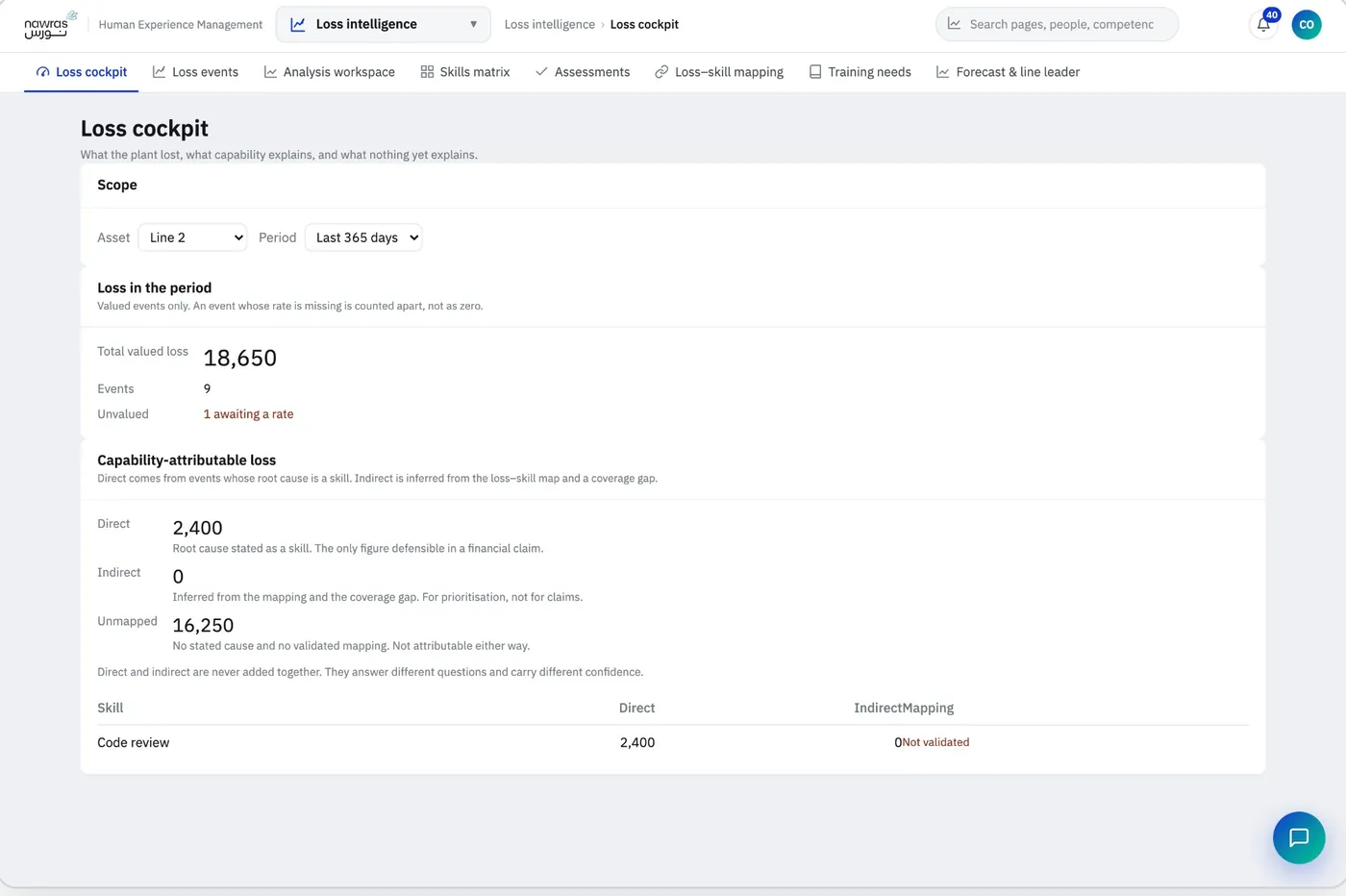
The screen that turns a training request into a business case. It prices a period: what went wrong, what each event cost at the rate recorded when it was logged, and — the line that gets budgets approved — how much of that total a capability gap accounts for. The figure is computed from the same skill records your job profiles use, not asserted in a slide, and it separates loss that is directly attributable from loss that is indirect and loss nobody has mapped yet. Finance can argue with the rate. They cannot argue that the number was invented.
Product screenshot
What the module does
Losses valued when they happen
Each loss type carries its own rate, so an event is priced as it is logged rather than estimated months later by whoever is left in the room.
Root cause traced to a named skill
Events link to the same skills the job profiles require, which is what turns “human error” into a specific, fixable capability.
The capability share, calculated
How much of the period’s loss a capability gap accounts for is computed and stated — the sentence that gets a development budget approved.
Who can run what, and where you are exposed
A skills matrix per line and asset shows single points of failure before the person concerned takes leave.
Training justified by the loss it prevents
Forecast need is expressed as the capability to build and the money it is expected to save.
Let's find the right solution for your business
Tell us about your team and what you need, and we'll set up a demo built around your real work.