



Insights: Reports & Dashboards
Answers your executives can act on, without a data breach in the footnotes.
One reporting engine across every module, with the confidentiality rules applied while the question is being asked — not to the rows after they have already been fetched.
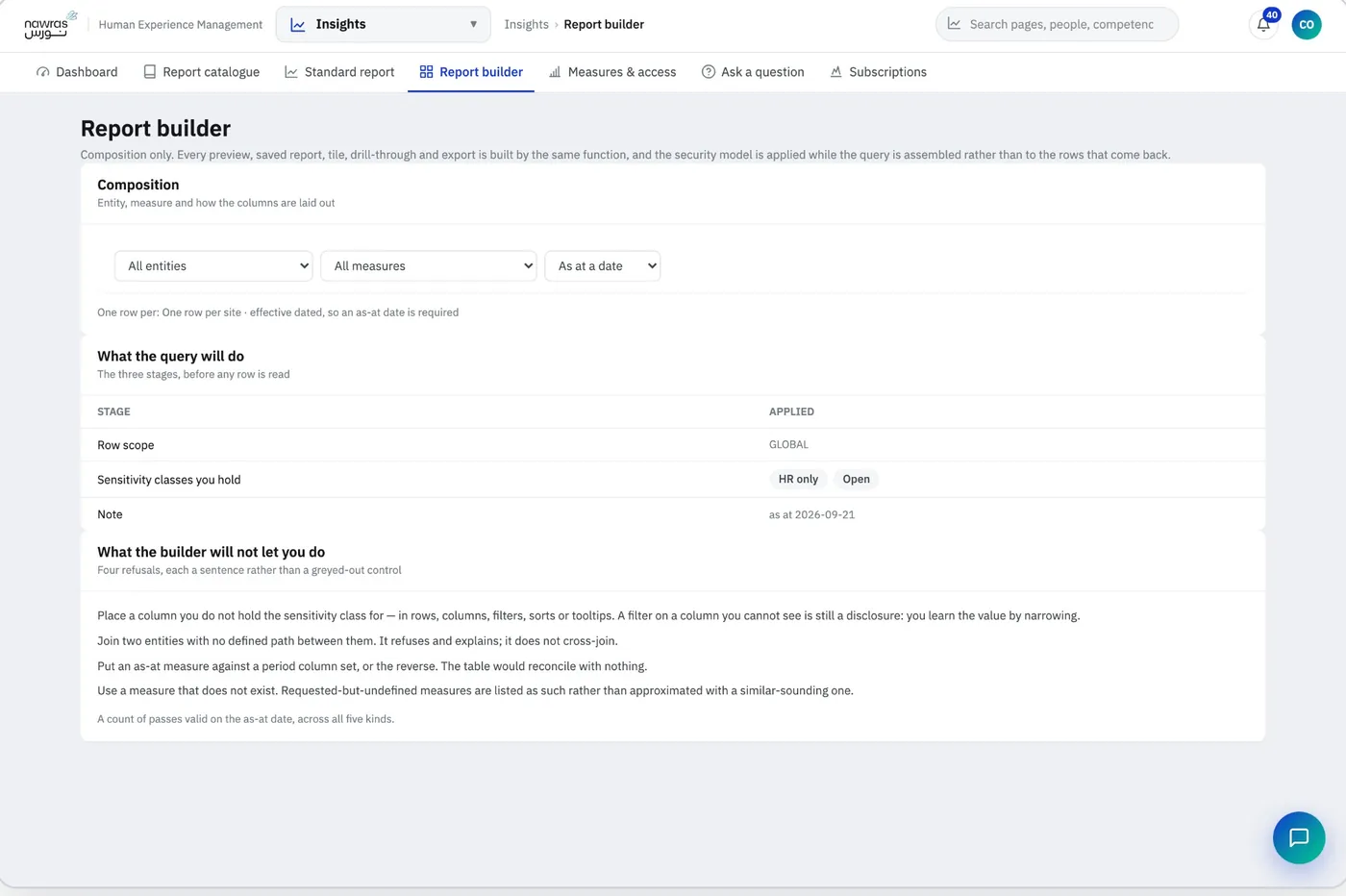
A report builder that tells you what it will refuse before you build anything. It states, in plain sentences, the three stages the query runs through, the scope your role carries, the sensitivity classes you hold, and the default filters already applied — then lists what it will not let you do and why: a column you may not hold, a filter that would disclose by narrowing, a measure nobody has defined. Preview, saved report, dashboard tile, drill-through and export all run through this one engine, which is why a rule fixed once is fixed everywhere, including the two routes that usually leak.
Product screenshot
What the module does
One engine behind every route
Preview, saved report, dashboard tile, drill-through and export are the same query. A rule fixed once is fixed in all five, including the two that usually leak.
Sensitive data cannot slip sideways
A column you may not hold is refused with a sentence that says why. Filtering or sorting on something you cannot see is treated as the disclosure it is.
Every figure has an owner
A number nobody owns is not published. Measures people have asked for but never defined are listed as undefined rather than approximated.
Trends, captured as they happen
Dated snapshots freeze their own context, so somebody who moved in June still appears in the March figures under the unit they were in.
Small groups protected automatically
Below the minimum group size a result is suppressed and the screen says so, rather than rounding an individual into a statistic.
Let's find the right solution for your business
Tell us about your team and what you need, and we'll set up a demo built around your real work.