



Talent Foundation
Know what your people can actually do — and what your jobs actually need.
Job requirements and employee capability are drawn from the same catalogue, so a skills gap is a number you can act on instead of an opinion you can argue with.
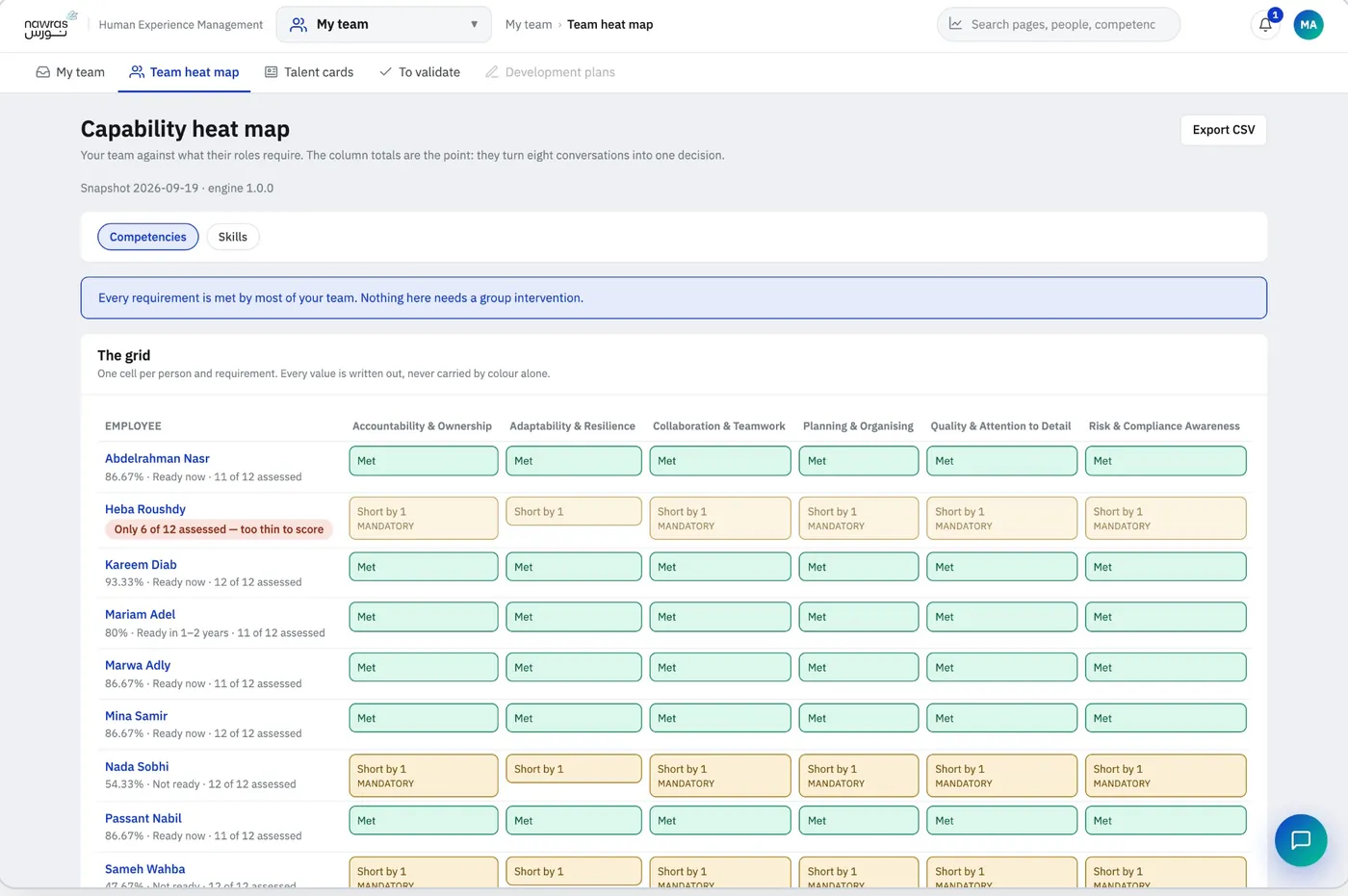
One screen, one team, and no ambiguity about where it stands. Every row is a person, every column a competency their role actually requires, and every cell says Met or Short by one in words as well as colour — because a heat map that only uses colour is unreadable to a tenth of the people it is shown to. The percentage beside each name is a match against their own job profile, with the evidence behind it stated: eleven of twelve assessed, not a number pretending to be complete. The column totals at the foot are what a manager buys this for: they turn eight separate development conversations into one decision about the team.
Product screenshot
What the module does
One language for capability
Every job profile and every assessment draws on the same framework, so a competency means the same thing in every country you operate in.
Every role described the same way
Job profiles carry the competencies, skills and levels the role requires, approved before they take effect and versioned when they change.
The gap, calculated once
One engine produces the capability gap and match score every screen reads. Two managers asking the same question get the same answer.
Honest about what you do not know
Where nobody has been assessed the system says so rather than scoring zero. A high match on thin evidence is labelled as exactly that.
Succession without a workshop
The same match runs against any role, so “who could step into this job” is a question you ask the system, not a meeting you schedule.
More HR modules
Let's find the right solution for your business
Tell us about your team and what you need, and we'll set up a demo built around your real work.